

Newton Abbot housing scheme faces crunch moment in ‘priceless’ fen row
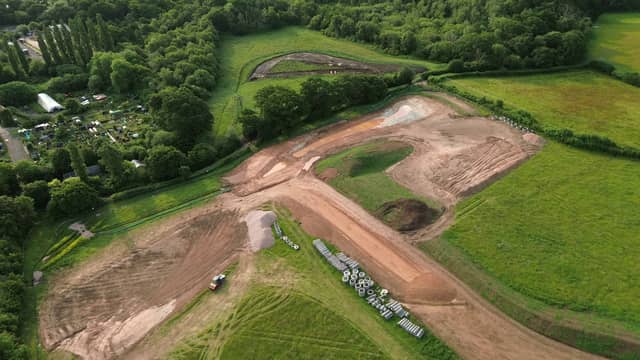

The latest stage of a long-running planning dispute has ended, with campaigners and the developer making sharply contrasting claims about the future of Wolborough Fen
The future of a huge housing development on the outskirts of Newton Abbot and a ‘priceless’ nature reserve alongside it will be decided in the next few weeks.
Government-appointed planning inspector Andrew Dawe has concluded a planning hearing after days of evidence over Wolborough Fen, which is a designated Site of Special Scientific Interest (SSSI) alongside part of the NA3 housing development site.
Around 1,200 homes will be built as part of the overall scheme, with developer Vistry Homes currently building the section alongside Wolborough Fen, which has been described as ‘priceless’ by local environmental campaigners.
Vistry appealed as a result of Teignbridge Council’s inability to reach a timely decision on the issue. At the heart of the long-running wrangle is the way water from the buildings drains into the fen.
The developer says the fen is safe and will not be adversely affected. Local campaigners, however, say its delicate ecosystem is in jeopardy.
Work on the site was halted for several weeks last year when Teignbridge Council stepped in amid concerns that Vistry had overstepped the permissions given by local planning councillors for the project.
Work has since restarted, with Vistry saying everything is being done within the permissions issued.
Expert ecologists have given evidence for both sides during the hearing, and Mr Dawe has been on a site visit to see the area for himself. He will now consider his judgement following the appeal hearing.
Appearing on behalf of Teignbridge Council on the final day, solicitor Jonathan Ward said the developers had not taken sufficient measures to ensure that the homes did not have a detrimental impact on the fen’s delicate ecosystems.
Its assurances were not sufficiently robust, he said, adding: “Important uncertainties exist.”
Better site investigations were needed, he went on, along with better sampling and better modelling of the effects.
There was, he added, a ‘fatal flaw’ in the current model.
Solicitor Jack Parker, on behalf of the Wolborough Residents Association and the Devon Wildlife Trust, went on: “The flaws in this scheme and the assessment of it are gaping and many.”
He disputed the claims that there would be no adverse impact on the fen and criticised the model being used by the developers to predict the outcome.
He said Vistry’s legal submissions had focused on ‘irrelevant matters’, including the motivation of the association and the trust.
Earlier in the appeal hearing, Mr Banner had referred to residents’ association supporter David Knopfler, who co-founded the band Dire Straits with his brother Mark, as a ‘deep-pocketed rock star’.
That prompted an angry response from Mr Knopfler, who pointed out that he had left the band more than 45 years ago and was a retired social worker living in a semi-detached house.
“Do not be distracted by such tactics,” Mr Parker urged the inspector. “There are numerous fundamental flaws in the scheme, and the inspector cannot be satisfied that there will be no adverse effects.
“The appellants simply have not done the work, and without that work being done there is no basis for accepting their case at this time.”
For Vistry, King’s Counsel Charles Banner replied: “More can always be done. The question is, has enough been done?”
He laid out detailed reasons why the developer believes it has done enough and said there was nothing to suggest any doubt around the opinions of the government watchdog Natural England, which stated some time ago that it believed the fen was safe.
“There is sufficient confidence to conclude that the fen is adequately protected,” he said. “The other parties are seeking a level of precision which is not required.”
And, he said, the fen would naturally evolve and adapt to some changes in its drainage.
Mr Dawe is expected to announce his findings later this year.