

Old Crockern, help us protect our beloved Moor!
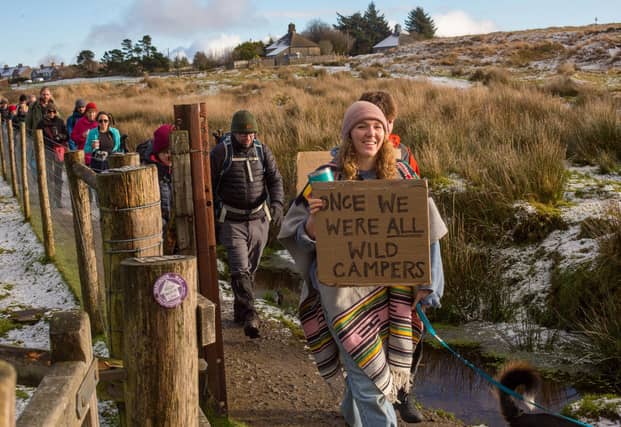

By now, everyone will have heard the devastating news. On Friday, 13th January, (an unlucky day indeed) the High Court ruled against Dartmoor National Park Authority in the case of Darwall vs DNPA. Wild camping on Dartmoor’s privately-owned land, without
By now, everyone will have heard the devastating news. On Friday, 13th January, (an unlucky day indeed) the High Court ruled against Dartmoor National Park Authority in the case of Darwall vs DNPA. Wild camping on Dartmoor’s privately-owned land, without permission from the land owner, was outlawed.
The;Dartmoor;Commons Act was enshrined into law in 1985. This law was ‘An Act to constitute the Dartmoor Commoners’ Council for the maintenance of and the promotion of proper standards of livestock husbandry on the commons in and about the Dartmoor National Park; to regulate public access to the commons; to confer powers on that Council and on the county council of Devon with reference to those commons; and for connected and other purposes’.
The Act states: ‘Subject to the provisions of this Act and compliance with all rules, regulations or byelaws relating to the commons and for the time being in force, the public shall have a right of access to the commons on foot and on horseback for the purpose of open-air recreation…’ And it is this statement upon which everything turned.
Alexander Darwall, a landowner and hedge fund manager, and his wife, Diana, own 4,000 acres of Dartmoor, 3,513 of which was previously open for wild camping - the Blachford Estate. The Darwalls run deerstalking and pheasant shoots on their land and have holiday cottages to let. In June last year, when the byelaws were being updated and the public asked their opinions on the changes, the Darwalls mounted a legal challenge to the presumed right to wild camp on the estate. They questioned the right to camp across all of Dartmoor’s commons on the grounds that they were worried about the harm that could come to their cattle and fallow deer from people sleeping out in tents.
Darwall’s lawyers argued that wild camping did not count as a permitted recreational activity as it is not expressly mentioned in the 1985 law. One would be forgiven for thinking that such an argument surely wouldn’t ‘stand up in court’. If camping isn’t a recreational activity, what is it classed as? Timothy Leader, arguing for DNPA, counter-argued that the law was purposely written to be as wide as possible to include all kinds of recreational activities. He added that there was a list of prohibited activities, such as killing animals or lighting fires and camping was not included in that list.
However, Sir Julian Flaux, the chancellor of the high court, clearly isn’t one for spending the night in a sleeping bag on a roll mat and ruled that Darwall’s lawyers were correct and that the right did not exist across Dartmoor.
“In my judgment, on the first issue set out … above, the claimants are entitled to the declaration they seek that, on its true construction, section 10(1) of the 1985 Act does not confer on the public any right to pitch tents or otherwise make camp overnight on Dartmoor Commons. Any such camping requires the consent of the landowner.”
Sir Julian stated that if there were a right to wild camp, it would mean ‘the landowner would have suffered a loss of control or a usurpation of his rights over his own land’.
He continued that there was ‘no local custom of camping which has the force of law’ and it was ‘apparent’ that some wild campers on the Darwalls’ land did ‘cause problems in relation to livestock and the environment’.
Dr Kevin Bishop, Chief Executive/National Park Officer for Dartmoor National Park Authority, said: “We are really disappointed with the outcome but obviously respect the judgment. We will now consider our position carefully before deciding on whether to appeal and on what grounds.
‘In the meantime, we will amend our website and other information we provide to people who are planning to wild camp on Dartmoor.
‘We are keen to work with landowners and other stakeholders to see how we can sustain opportunities for people to wild camp on Dartmoor. We’re meeting with Dartmoor Common Owners’ Association in coming days and hope to ensure that, with the agreement of landowners, the opportunity to wild camp as it existed prior to this judgment is secured going forward.
‘We maintain that wild camping is an important form of open-air recreation and is a way to enjoy the special qualities of the National Park – for example the dark night skies, sense of wilderness and the tranquillity that can be derived from the commons of Dartmoor. Done properly, and with respect, it has little impact on the environment but can have significant health and wellbeing benefits.”
Wilderness guide Emma Lindford, who leads the campaign group The Stars Are for Everyone, said they wouldn’t give up without a fight. “From the outset it was clear that this whole case had nothing to do with the preservation of Dartmoor's delicate ecology,” she said. “Instead, this was always one landowner’s naked attempt to find any pretext to roll back the public’s right to connect with nature on national parkland.”
And so, we come to Old Crockern, who is the guardian spirit of Dartmoor and has, if the myths are to be believed, protected his home in the past. In times past, a wealthy farmer from Manchester moved to Dartmoor to increase his piles of gold from the land. He believed himself above the local farmers, cleverer and more sophisticated. He believed he could turn a tidy profit from the moorland with the use of materials and machinery his lowly neighbouring farmers couldn’t afford. But one day he met with an old man who warned him against his plans. The old man told him that Old Crockern had a message for him.
“Tell the man that I know his mighty plans and that many such men have come to my land with the same intent but like them I promise him one thing, if he as much as scratches my back with a plough share, I’ll tear his pockets out.” (legendarydartmoor.co.uk)
The rich farmer scoffed. But as time passed, he failed to make a profit from his endeavours. Everything he tried failed, and the farmer found himself not so rich as before. He lost money in every scheme he tried and eventually gave up and left Dartmoor.
Following Friday’s decision, Right to Roam announced on Twitter: “Right to Roam goes to war. Today’s decision by the High Court to revoke the right to wild camp in Dartmoor – the only place in England it was legal – is an absolute outrage. Today Right to Roam launch a ferocious campaign to fight for our right to sleep under the stars.”
An open invitation has been extended to all for the gathering tomorrow (Saturday, 21st January) to raise the spirit of Old Crockern once more. Meet at Ivybridge train station at 1.30pm, wear warm clothes and sensible footwear and bring a drum or something to bang to help raise the spirit of Dartmoor.
On its event page, Right to Roam said: “Alexander Darwall, a multimillionaire estate owner in South Dartmoor, has used his wealth and entitlement to remove our ancient right to connect with the land: all by contesting a byelaw from the 1980s which simply acknowledged the long-established practice of sleeping under the stars.
W?e say: absolutely not!
‘We are calling on the spirit of Old Crockern, the ancient protector of the moor, to oppose this decision. Old Crockern represents the values that sit within our campaign and those that embody Dartmoor: inclusivity, freedom, growth, relationship and humanity.
‘We call on the many generations of people who love Dartmoor: locals, visitors, campers, farmers, walkers, students, naturalists, land workers, fishers, climbers, swimmers, bikers, canoeists, stonewallers, hedge layers, spirits old and new, to join us in opposition.”
https://www.eventbrite.com/e/raise-old-crockern-to-defend-dartmoor-tickets-514716339427.