

TBC: 1066 comes to life at Exeter museum

More than 950 years after William the Conqueror crossed the Channel to claim the English throne, the story of the Norman Conquest is returning to Exeter through coins, pottery and fragments of architecture unearthed in the city.
From 15 September 2026 until 11 July 2027, Exeter’s Royal Albert Memorial Museum & Art Gallery (RAMM) will host a special display exploring the city’s connections with the events surrounding 1066, as part of Bayeux Around Britain, a nationwide programme celebrating the return of the Bayeux Tapestry to the UK.
The British Museum’s partnership programme, supported by WorldQuant, involves more than 60 organisations around the country, giving communities the opportunity to explore the history behind the famous medieval embroidery through local collections, exhibitions and events.
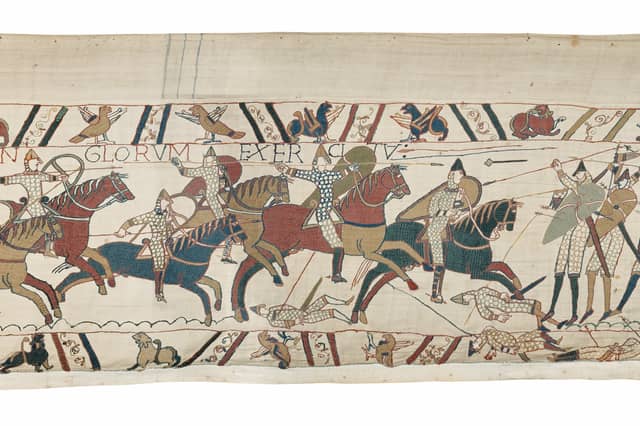
The Bayeux Tapestry itself — a remarkable 70-metre-long embroidered account of the Norman Conquest — is being displayed at the British Museum from 10 September 2026 to 11 July 2027.
Created in the 11th century using wool thread on linen, the tapestry depicts the events leading up to the Norman invasion and William, Duke of Normandy’s conquest of England in 1066.
Its 58 scenes, 626 characters and 202 horses provide an extraordinary window into medieval life in Normandy and England, depicting everything from warfare and seafaring to clothing, buildings and everyday activities.
But while the tapestry tells the story from across the Channel, Exeter’s archaeological record provides its own local chapter.
The city had strong connections with France during the period of the Norman Conquest, and archaeological discoveries from Exeter reveal the changes brought by the arrival of the Normans.
RAMM’s new display will include coins minted in Exeter depicting three of the central figures associated with the conquest: Edward the Confessor, Harold II and William I.
Pottery excavated in the city provides another glimpse of the transition from Saxon to Norman culture, including examples of both Saxon and Norman pottery as well as vessels made by a French potter who was living and working in Exeter before the Norman Conquest.
The display will also feature fragments of the new forms of architecture introduced by the Normans. Together, the objects offer a chance to look beyond the better-known scenes of the Bayeux Tapestry and consider what the events of 1066 meant on the ground in a city that experienced the transformation first-hand.
The RAMM display and a related trail through the museum’s galleries have also been created with the help of a younger generation. Four participants in RAMM’s Skills Development programme; Conan Esson, Harry Gibbs, Alex Lake and Octavia Madden have spent recent months working alongside curator Thomas Cadbury to select objects and develop the interpretation for visitors.
The Exeter display is part of a wider programme of events linked to Bayeux Around Britain. A nationwide celebration of craft inspired by the Bayeux Tapestry is planned for spring and summer 2027 in partnership with the Craft Council.
Closer to home, the Friends of RAMM will host Conquered: Norman Exeter and Devon, bringing together archaeological and historical perspectives on the Norman takeover.
Speakers will include John Allan, Cathedral Archaeologist; Ollie Creighton, Professor of Archaeology; Sarah Hamilton, Professor of Medieval History; and Levi Roach, Professor of Medieval History, all from the University of Exeter.
RAMM will also welcome Michael Lewis, Lead Curator of the British Museum’s Bayeux Tapestry exhibition, for an in-person talk on Thursday 15 April 2027.
The programme means that visitors to Exeter will be able to explore the wider story of 1066 while the original tapestry is on display in London, linking the national history of the Norman Conquest with the archaeological evidence found much closer to home.
Dr Nicholas Cullinan OBE, Director of the British Museum, said: “Since this loan was announced last year, we have been committed to making this a significant cultural moment for the whole of the UK. The Bayeux Around Britain programme will help ensure that this once-in-a-generation exhibition is not confined to Bloomsbury but accessible to tens of millions of people around the country.”
Cllr Lucy Findlay MBE, Exeter City Council lead for City and Culture, said: “We’re delighted that RAMM is part of the Bayeux Around Britain programme. Exeter has a unique connection to the story told by the Bayeux Tapestry, and this display offers a wonderful opportunity to explore that history through objects from RAMM’s collection. It’s especially encouraging to see young people helping to curate the exhibition and interpret our heritage for new audiences.”
For Exeter, the project offers a chance to put the city firmly into one of the most famous stories in English history, and to discover what the objects left behind can tell us about life in the city before, during and after the Norman Conquest.
With the Bayeux Tapestry itself temporarily back in Britain for the first time in decades, the story of 1066 is being told not just through its famous embroidered scenes, but through the local evidence of a city transformed by them.