

Pictures: Castle Drogo hosts powerful women’s history art exhibition this March
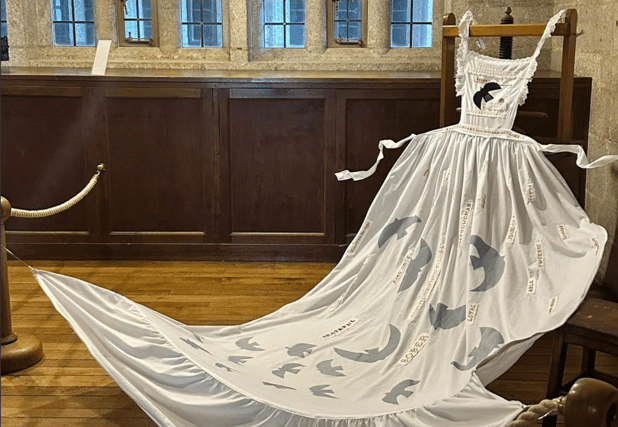

A Woman’s Place reflects on domestic roles and social expectations in the Victorian and Edwardian periods
A Tavistock-based arts collective are presenting a month-long exhibition at Castle Drogo this March, exploring the lives of women connected to the historic estate on Dartmoor.
The Herding Cats Arts Collective are staging ‘A Woman’s Place’ within the National Trust property’s walls.
The work focuses on the domestic and social structures that shaped women’s lives in the late nineteenth and early twentieth centuries.
In collaboration with the castle’s historians, the group have researched the lives of women who lived and worked at Drogo throughout the Victorian and Edwardian eras.
‘A Woman’s Place’ draws on objects, imagery and domestic materials to examine how women inhabited and negotiated the spaces assigned to them.
Artist and group member Sara Venner said: “As artists we are the voices of the women lost to history, revealing feminine lives lived in different times. I feel my work has been enriched by its historical context.”
Castle Drogo was designed ‘by a man, for a man’, with renowned architect Edwin Lutyens curating the fortress for businessman Julius Drewe in the early 20th century.
Although built as a symbol of permanence and legacy, Drewe lived only briefly in the finished building.
In his absence, the castle became a predominantly female space, occupied by his wife and children and supported by a workforce largely made up of women.
The collective say the exhibition “considers how women inhabited and negotiated the spaces assigned to them and how their histories are recorded or lost”.
Working-class women often entered domestic service, while upper-class women were typically expected to marry, raise children and pursue approved domestic or artistic interests.
Independence and authority for women were limited, regardless of their social group or circumstance.
A Woman’s Place explores the idea of “place” as both a physical location and a set of social expectations.
It reflects on how labour, care and resilience functioned within systems not designed to grant women agency, and asks how those histories are recorded, or overlooked.
‘A Woman’s Place’ is running at National Trust property Castle Drogo, near Drewsteignton, and visitors can see the exhibition running throughout this month (March 2026).