
Hennock school table tennis opening
Search


07 Mar 2026

Please allow ads as they help fund our trusted local news content.
Kindly add us to your ad blocker whitelist.
If you want further access to Ireland's best local journalism, consider contributing and/or subscribing to our free daily Newsletter .
Support our mission and join our community now.
To continue reading this article, you can subscribe for as little as €0.50 per week which will also give you access to all of our premium content and archived articles!
Alternatively, you can pay €0.50 per article, capped at €1 per day.
Thank you for supporting Ireland's best local journalism!

North Devon MP Ian Roome backs UK under-16 social media ban as children spend hours on apps like TikTok and Instagram.
The government has launched a consultation on banning social media for under-16s in the UK, in a move aimed at “protecting young people's wellbeing”.
The proposals also give England’s education inspectorate, Ofsted, the power to check schools’ phone policies, with ministers expecting schools to be “phone-free by default”.
North Devon MP Ian Roome welcomed the consultation, with his party, the Liberal Democrats, having long raised the alarm about social media harms, calling them a public health crisis.
“If a platform spreads harmful content or relies on addictive and harmful algorithms, it should not be allowed anywhere near our children,” Mr Roome said.
“As a dad and a grandad, I completely understand why parents are so worried about this.
“The harm-based approach put forward by the Liberal Democrats would protect children from the worst of the online world and provide a strong incentive for platforms to remove addictive algorithmic features and harmful content. Tech companies have treated children as data to be mined rather than young people to be protected for far too long, and have built addictive algorithms designed to keep children endlessly doom-scrolling at the expense of their mental and physical health, their sleep and their concentration.
“Much more needs to be done to address the harms that children are currently exposed to on social media platforms and I will continue to hold the government accountable for protecting our children online.”
Reaction in North Devon is mixed. Dave Jones told the Gazette’s Facebook page: “No. Absolutely not.”
Kerry Louise said: “Under 18s with what I've recently dealt with.”
Meanwhile, Timothy Down suggested moderation rather than a full ban: "No I don't but do think restrictions should be put on. Only message friends, profile private automatically."
The Liberal Democrats have long called for stronger regulation of social media, arguing that children are being treated as “data to be mined” rather than young people to be protected. Their proposals include:
Under this model, the most harmful platforms would be rated 18+, while a default 16 rating would apply to most social media.
Crucially, the approach allows children access to educational sites such as Wikipedia and online crisis services, which could otherwise be caught up in a blanket ban.
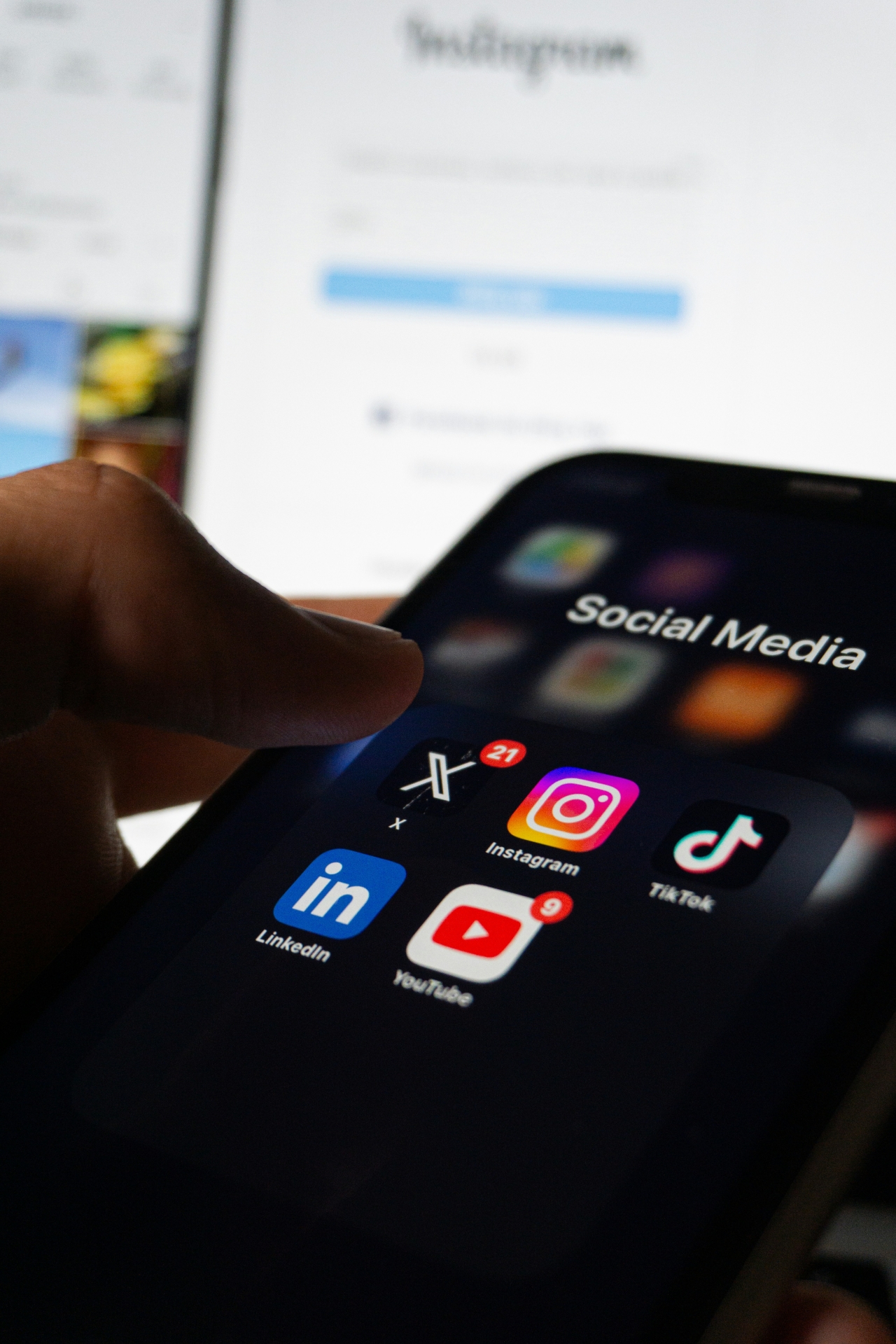
ABOVE: Popular social media apps such as TikTok, Instagram, and Snapchat are under scrutiny as the UK government consults on a potential under-16 ban to tackle online harms and addictive content. Photo by Berke Citak on Unsplash.
Ofcom data published in December 2025 shows that children aged eight to 14 spend almost three hours online daily, rising to four hours for 13 to 14-year-olds.
YouTube and Snapchat dominate, with 48 minutes per day spent on YouTube and 45 minutes on Snapchat.
Other popular platforms include WhatsApp (63 per cent) and TikTok (58 per cent).
Late-night usage is common, with 15 to 24 per cent of time on YouTube, Snapchat, TikTok, and WhatsApp occurring between 9pm and 5am.
Four to ten per cent of usage happens after 11pm, depending on the platform.
Despite concerns about screen time, most children report positive experiences online.
Nine in ten (91 per cent) said they were happy with the activities they undertake online, while nearly eight in ten (78 per cent) said the internet helps with schoolwork.
Over half (55 per cent) use it to learn new skills, and seven in ten 13 to 17-year-olds said they go online to support their wellbeing.
Ofcom found that seven in ten 11 to 17-year-olds had encountered harmful content online in the previous month, including violent, hateful, or self-harm material.
Nearly two-thirds of children took action in response, such as using platform tools, reporting content, blocking users, or speaking to an adult.
Children described the overstimulating, chaotic nature of this content as causing “brain rot”.
New rules under the Online Safety Act, which came into effect in July 2025, require platforms to prevent children from seeing content related to suicide, self-harm, eating disorders, pornography, misogyny, bullying, and dangerous challenges.
Platforms must also improve reporting tools and age checks.
The UK is following the lead of Australia, which introduced a world-first under-16 social media ban in December 2025.
-1768916161174.jpg)
ABOVE: Australia’s Prime Minister Anthony Albanese (pictured) introduced the world’s first under-16 social media ban, with legislation passed in 2024 and enforced by the eSafety Commissioner from December 2025.
The measure has prompted other countries to consider similar action to protect young users from addictive algorithms and harmful content.
The government’s consultation is open until the summer, when ministers are expected to respond with their proposals.

Subscribe or register today to discover more from DonegalLive.ie
Buy the e-paper of the Donegal Democrat, Donegal People's Press, Donegal Post and Inish Times here for instant access to Donegal's premier news titles.
Keep up with the latest news from Donegal with our daily newsletter featuring the most important stories of the day delivered to your inbox every evening at 5pm.