

Haldon Forest could become Devon stronghold for threatened adders
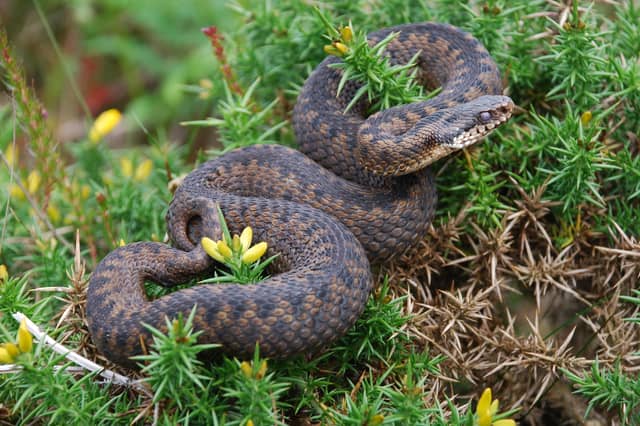

Deep among the trees and heathland of Haldon Forest, a quiet conservation project is shedding new light on one of Britain’s most misunderstood reptiles.
A pioneering study is revealing how adders move through the landscape, where they choose to live and which habitats they rely on, with researchers finding that Haldon could have the potential to become an important regional stronghold for the threatened species.
The research is believed to be the first study in Devon to use small radio tags to track individual adders. The first year of what is planned as a much longer-term project has already provided Forestry England with valuable information that could influence the future management of Haldon Forest.
The study found that adders have a strong preference for connected areas of open habitat, including heathland, recently replanted woodland and the edges of existing forest.
Although these habitats are already scattered across Haldon, the research suggests that ensuring they remain connected could be crucial, allowing snakes to move between areas, find mates and maintain healthy populations.
Perhaps more surprisingly, many of the adders studied remained within relatively small home ranges. Female adders had the smallest ranges, while males tended to congregate around them. This means that particular areas of the forest can become important adder ‘hotspots’, where several animals depend on the same patches of suitable habitat.
Protecting these locations could therefore be especially important for the future of the population.
Adders are one of only three native snake species found in Britain and are the country's only venomous snake. Although they are protected by law, their numbers and distribution have declined significantly in many parts of Britain.
Habitat loss and fragmentation are among the pressures facing the snakes, alongside being hunted by birds and mammals and disturbance from people and dogs.
Haldon Forest has recorded adders since the forest was established in the 1920s, but until now there has been relatively little detailed information about the size and behaviour of the local population.
The forest’s unusual combination of heathland, open areas, woodland of different ages and a large area managed as one landscape gives conservationists an opportunity to create and maintain the connected habitats adders need.
Forestry England believes this could eventually make Haldon one of the most important sites for adders in the region.
Aaron Boughtflower, Forestry England ecologist said: "Adders are a fascinating and beautiful part of our native wildlife. They're an important part of healthy ecosystems, but across the country they're facing an uncertain future. We're lucky to have a breeding adder population at Haldon Forest but, until now, we've known relatively little about how they use the landscape.
"This research has given us incredibly detailed information that will help us make better decisions for both adders and the wider forest. We can use the evidence to inform our habitat restoration, improve habitat links across the forest, and support the long-term recovery of this important population.
"This is only the beginning of a long-term programme of work. As we continue to learn more, we'll keep adapting how we care for Haldon Forest and help more people appreciate these remarkable animals."
The research began after several years of surveys to identify areas where adders were likely to be found. As the snakes emerged from their winter hibernation in spring, researchers located individual animals and fitted 10 of them with small, temporary radio tags attached to their tails. Each snake was measured, weighed and photographed before being returned to exactly where it had been found.
Researchers then tracked the tagged adders every two to three days using a radio receiver. GPS locations were recorded throughout the study, building up a detailed picture of where individual snakes travelled and which habitats they selected.
The tags were designed to be temporary. They naturally detached when the adders shed their skins, around two months after they were fitted. This allowed researchers to collect detailed information about the snakes' movements without leaving a permanent tag on the animals.
Traditional adder surveys can be tricky because the snakes are often difficult to spot, particularly across a large and varied landscape. Researchers may repeatedly search an area without knowing whether an individual snake is nearby, but hiding. Radio tracking changes that, allowing researchers to locate tagged snakes even when they are concealed in vegetation or underground. The result is a much clearer understanding of how individual animals use their surroundings.
One of the most significant findings from the first year is that the adders did not necessarily range widely across Haldon. Instead, many remained surprisingly close to the places where they were first discovered. For conservationists, that makes the condition and connectivity of relatively small areas of habitat particularly important.
The research indicates that protecting female adder habitat could be especially valuable, as their smaller home ranges may make them more dependent on specific locations. With males gathering around these areas, the same sites can support several individuals and potentially play an important role in breeding.
The findings give Forestry England a more detailed evidence base for decisions about woodland management and habitat restoration, helping identify where open areas could be maintained or enhanced and where links between suitable habitats could be improved.
Forestry England has secured funding to continue the study for another three years, with adders in additional areas of Haldon Forest due to be tracked.
The expanded research should build a much larger picture of the population and its movements, helping conservationists understand whether the habitat improvements being made across the forest are benefiting adders over time.
For a species that is often viewed with fear, the project also offers an opportunity to change perceptions. Adders are shy and generally avoid people, and their role as a native predator forms part of the wider ecosystem. Understanding where they live and what they need could help ensure that people and wildlife can continue to share Haldon Forest.