

Tymescythe Theatre's Band of Brothers

On a dark and stormy night in late March, I ventured outside into the whistling wind with a bottle of red wine clutched to my chest. Battling through the howling tempest, I arrived bedraggled and drenched at the home of actor and theatre director, Tom Fynn.
Tom relieved me of my water-logged coat and, with brisk energy, ushered me through a labyrinth of rooms, past piles of theatrical props and rails of costumes into his warm cottage kitchen. Here, we were joined by his mother, Sonia Fynn, an accomplished and successful artist in her own right. ‘We happy few’ settled down next to the Aga and opened the wine. Our conversation flowed, enlivened by Tom’s wit and erudition.
Chagford-based Tymescythe Theatre was formed in the early 1990s with a vision to produce high quality theatre in which volunteers work alongside professionals. Since 2015, the company has presented its plays within the ancient walls of St Michael the Archangel in Chagford. During the run of a play, extensive staging transforms the Grade 1 listed church into a unique, atmospheric theatre, its stage constructed over the front pews and framed by soaring mediaeval granite pillars.
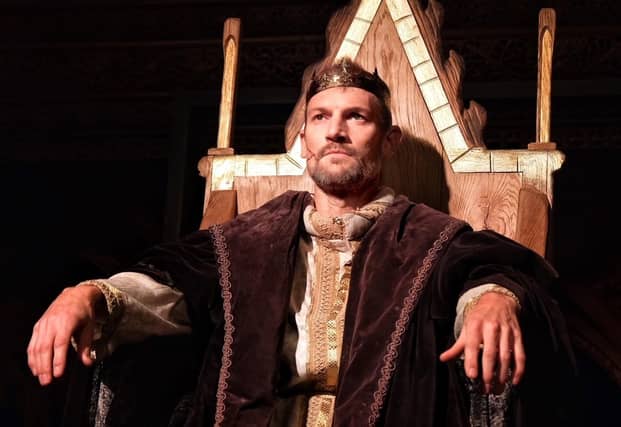
Last month, Tymescythe presented Shakespeare’s ‘Henry V’. The entire run of the play was a total sell-out with some remarkable and penetrating performances, not least of which was Tom himself as Chorus, the single character who introduces the acts, helps the audience follow the play, and invites them to awaken their imaginations. During his soliloquies, Tom held the performance space with spell-binding presence; he is a totally committed actor with a profound stillness at the core of his being.
Elizabeth-Jane (EJ): What made you choose Henry V?
Tom Fynn (TF): I just think it’s a brilliant play. It’s peak Shakespeare, written around the same time as Hamlet, and it’s full of the very best stuff. Because it’s not performed as often as some of the other plays, it offers some surprises for the audience. Like the conjuring of things out of thin air with poetry, jumping around in time and space, creating visions. It’s a play about imagination.
Chorus says:
Think when we talk of horses, that you see them
Printing their proud hoofs i’ the receiving earth;
For ’tis your thoughts that now must deck our kings,
Carry them here and there; jumping o’er times,
Turning the accomplishment of many years
Into an hour-glass.
Another surprise might be the amount of silly jokes and fun. Most people would expect inspiring speeches and heroic scenes in Henry V, not a load of jokes about leeks.
EJ: What is your method, approach or working style?
TF: I definitely don’t try and ‘do a take’ on a classic text like a Shakespeare play. I try to work towards the vision of the play as written and I consciously avoid twisting or changing the underlying intention as I understand it. I don’t think I’m a purist or stuck on historical accuracy: I like (and have done) Shakespeare productions using modern dress and sets. But I try not to burden the play with anything that doesn’t naturally belong to it.
The actors were incredible. It’s a huge privilege to work with talented people as characters emerge. Sometimes that all happens in a flash, sometimes they manifest slowly. Sometimes I notice I’m letting go of my own initial idea for something else, because what’s coming out in rehearsal is naturally taking over. That’s when I feel we’re going in the right direction. So, I’d say my style is collaborative and actor-centred, but that doesn’t mean soft.
A huge amount of ‘Henry V’ is in verse, so it’s very important that actors have a good grounding in how it works. The rhythm and metre are a big part of how the actors band together: some scenes work like one big poem, where one character takes over from another in the middle of a line of verse. The trick is getting the rhythm and metre to work for the actor, to bring it out without becoming stilted or mechanical.
I try to keep my focus on making a show entertaining. Entertainment is everything, because entertainment is attention. Without attention, nothing’s happening.
EJ: Why do you feel that Shakespeare is suitable for a modern audience?
TF: Why should modern audiences be deprived of the good stuff? I don’t think Shakespeare’s really that difficult or obscure. The technical stuff, acting technique and so on, helps communicate the story to audiences. But the most important thing is for actors to have a deep understanding of what they’re saying and doing. If that’s there, audiences will understand.
EJ: What are your tips on how to manage local theatre productions?
TF: A show like this is a creative collaboration involving a huge number of people, all serving a vision which is changing daily, a tale which grows in the telling. There’s nothing like it! But don’t expect anything less than incredible intensity. So strap in. I’m so grateful that so many frankly amazing people gave to this show to make it what it was. Costume, lighting, graphic design, set, props and stage building to name some of the areas.
EJ: Why do you choose Dartmoor over London?
TF: There’s no Sandy Park Inn in London.