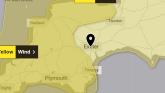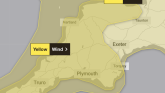
Met Office warns Storm Bram may intensify impacts over Devon as conditions deteriorate Image- Met Office
Search


08 Dec 2025

Please allow ads as they help fund our trusted local news content.
Kindly add us to your ad blocker whitelist.
If you want further access to Ireland's best local journalism, consider contributing and/or subscribing to our free daily Newsletter .
Support our mission and join our community now.
To continue reading this article, you can subscribe for as little as €0.50 per week which will also give you access to all of our premium content and archived articles!
Alternatively, you can pay €0.50 per article, capped at €1 per day.
Thank you for supporting Ireland's best local journalism!

Torbay Council (Image courtesy of: Lewis Clarke)
The future shape of Devon will be decided behind closed doors at Whitehall in the New Year.
A decision taken at the Ministry of Housing, Communities and Local Government will affect the lives of everyone in the county – and that’s well over a million people.
It will determine the future shape of social care for vulnerable children and adults, as well as shaping housing and public transport strategies going decades into the future.
Read next: Torbay budget proposes 4.75% Council Tax rise as consultation opens
In short, there will be new ways of deciding when your bins are collected, when your grass verges are cut and when somebody will finally come to fill the potholes in your street.
Almost below the radar as far as the vast majority of the public is concerned, every service and council function in Devon is about to change.
Councils that are good at adult social care could be pushed into a merger with councils that aren’t. Councils whose books balance will find themselves joined with councils whose books show cause for concern.
Hardly anybody at local council level really thinks this is a good idea. One councillor told a meeting shortly after the shake-up was announced: “None of us bought a ticket for this ride. Our residents certainly didn’t.”
When Torbay Council launched a public consultation to find out what local people wanted in the future, backed by public meetings and information events, just 1,400 people filled in the forms.
That’s one per cent – just one filled-in form for every hundred people in the bay.
The government announced a year ago that it wanted to change the way councils worked all over the country. It wants to get rid of the current structure altogether, and replace it with a network of unitary councils with responsibility for everything.
That will replace the current, complex system in which Devon County Council is responsible for functions like highways and education while district councils like those in North Devon, West Devon and Teignbridge administer their own planning, housing and other functions.
Exeter City Council holds district council status, but the councils in Plymouth and Torbay are so-called unitaries, meaning they control all of the combined functions of the county and district authorities.
It’s a complicated system, which will be massively simplified under the new arrangements. All Devon’s councils, of which there will be just three or four, will have the same ‘unitary’ status as Plymouth and Torbay do now.
Town and parish councils will remain as they are, at the most community-focused tier of local government. There have also been discussions over the creation of hyper-local councils or ‘boards’ to sit under the new unitaries in places like Exeter.
And then, sitting over all of this, will be a new ‘strategic authority’ which will probably have an elected mayor and will be the conduit between central government and the new unitaries.
Everyone assumed that Devon and Cornwall would be joined as one new strategic authority for the far south-west, but Cornwall very much did not want this to happen. Now it appears that the government has listened, and Cornwall will not be merged with anyone.
That leaves Devon potentially looking to the east for new partners, with Somerset and/or Dorset most likely to join it if the government decides that way. However, there are also reports that if Cornwall is to go it alone, Devon sees no reason why it shouldn’t be allowed to do precisely the same thing.
The government gave councils until November 28 to hand in their reports on what they each saw as the way forward. Here’s what they decided.
Devon County Council wants a ‘9-1-1’ system which it calls ‘New Devon’, in which Plymouth and Torbay remain as they are within their current boundaries. The remaining nine councils – Devon, Exeter and all the districts – form a third unitary with its ‘seat of government’ in Exeter
Plymouth City Council and Exeter City Council have presented a united proposal which suggests four unitary councils across the county. Plymouth would expand eastwards to absorb 13 South Hams parishes, while Exeter spreads to take in 49 East Devon, Mid Devon and Teignbridge parishes. Torbay expands to take in 21 Teignbridge and South Hams parishes and a fourth ‘Devon Coast and Countryside’ council takes in the rest of the county.
Torbay Council also proposes four unitary councils to cover Devon. The bay wants to stay exactly as it is, with no widening of its borders. It says its services are successful as they are. It proposes an expanded Exeter, an expanded Plymouth and a rural Devon authority to cover the rest.
The remaining district councils, which are West Devon, South Hams. Teignbridge, East Devon, Mid Devon, North Devon and Torridge were all early adopters of a ‘4-5-1’ plan of action, in which Plymouth would be the stand-alone ‘one’ in the equation. West Devon, South Hams, Torbay and Teignbridge would merge to form the ‘four’ while Exeter, East Devon, Mid Devon, North Devon and Torridge would be the ‘five’.
The government will consider all the proposals and is expected to announce its decision on the new shape of Devon in the late spring or early summer next year. There will be elections in May 2027 for membership of new ‘shadow’ authorities, which will take over lock, stock and barrel in May 2028.
Pundits are divided in their opinions about how it might go, but with a Labour government, Labour MPs in Plymouth and Exeter and Labour-controlled councils in both cities, it is hard to see ministers saying no to the cities’ proposals.
The principal doubt, therefore, is over the future shape of Torbay. Under the models put forward by the bay itself and by Devon County Council, its boundaries would stay as they are, which is what the bay wants. The other options would see it either spreading out into the surrounding countryside or merging with its neighbouring districts.

Subscribe or register today to discover more from DonegalLive.ie
Buy the e-paper of the Donegal Democrat, Donegal People's Press, Donegal Post and Inish Times here for instant access to Donegal's premier news titles.
Keep up with the latest news from Donegal with our daily newsletter featuring the most important stories of the day delivered to your inbox every evening at 5pm.