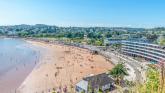
WATCH: Flames rip through derelict seafront hotel in Torquay (Image: Jim Parker)
Search


06 Apr 2026

Please allow ads as they help fund our trusted local news content.
Kindly add us to your ad blocker whitelist.
If you want further access to Ireland's best local journalism, consider contributing and/or subscribing to our free daily Newsletter .
Support our mission and join our community now.
To continue reading this article, you can subscribe for as little as €0.50 per week which will also give you access to all of our premium content and archived articles!
Alternatively, you can pay €0.50 per article, capped at €1 per day.
Thank you for supporting Ireland's best local journalism!

Onshore wind turbines near South Molton © Sharon Goble

The Government’s announcement that 157 new solar farms have secured contracts under its latest renewable energy auction, alongside support for the largest onshore wind scheme in England for a decade, has drawn sharp criticism from countryside campaigners in Devon.
The projects were confirmed as part of the Government’s latest Contracts for Difference (CfD) allocation round, aimed at boosting renewable energy generation and accelerating progress towards decarbonising the UK’s electricity system by 2030. Among the schemes backed is the Imerys Wind Farm near St Austell in Cornwall, described as the largest onshore wind project in England in ten years.
However, Devon CPRE, the countryside charity, has voiced strong opposition to the scale and long-term impact of such developments.
Devon CPRE Chair Steve Crowther said: “These headlines are shocking; however, actually these 157 solar farms already have planning permission. We do all need to now say ‘enough is enough’ before our countryside is desecrated beyond recognition, with nothing left to enjoy or protect.
“The government keeps pushing out the line about how more wind and solar will lower everybody’s electricity bills. But we all know the opposite is true. Do they think the public are fools? The boss of British Gas has warned that electricity in Britain is on track to cost more in 2030 than it did during the energy crisis triggered by Russia’s invasion of Ukraine.
“The original ethos behind all renewable energy schemes was that they would be ‘temporary blights on the landscape’, typically for about 25 years. As solar panels age, their efficiency decreases by between ½ and 1% per year. After about 30 years the benefit from a solar farm falls to such an extent that it can no longer be argued that it outweighs the harm to the landscape and the loss of productive farmland. ‘Indefinite’ consents are presented as meaning that the equipment will be removed when it has fully decayed; but in practice it means that they will be constantly replaced with new equipment. Indefinite effectively means ‘in perpetuity’.
“Our thoughts about another large wind farm in Cornwall? Unprintable! Devon CPRE led the opposition to numerous onshore wind turbines and wind farms over a decade ago. The landscape, particularly in north west Devon where there are so many, has been fundamentally altered. And now wind turbines are getting much taller, so they have significantly more impact over a wider area.
“We know that rural communities don't want these huge wind and solar developments imposed on them. Yet so often their opinions count for nothing. There's nothing democratic about a planning system that allows this to happen.”
In a recent e-bulletin, Devon CPRE said it believed pressure on agricultural land in the county would intensify, particularly as some developers seek to extend time limits on existing solar farm permissions.
The bulletin stated: “There is now a further sign that the battle to retain Devon’s landscape of prime grassland rather than glass-and-steel is going to intensify.
“One of the arguments which has consistently been used to justify the handing over of farmland to solar energy is that this is just a temporary change of use. Originally, 20 years, then 30, then 40 years was the ‘temporary’ period for which permission was applied. It was argued that the land would be returned to agriculture unharmed, and even apparently enhanced, at the end of that permitted duration.
“Well, we have now received notice of two applications to convert those ‘temporary’ consents into ‘indefinite’ periods of time; one in Shebbear in Torridge and the second near Morchard Bishop in Mid Devon. While the former argues on a commercial basis, the latter comes with an attempted environmental justification, claiming that solar farms have three times more birds than arable farmland. This claim is based on a study by Cambridge University; one wonders whether it was conducted on the flatlands of East Anglia or the rich hedged pastures of Devon.
“Both of these applications state that the land will be returned to agriculture ‘when the solar farm ceases to generate electricity’. But that will only happen if decaying solar equipment is not replaced. If it is, the ‘indefinite’ term will be effectively ‘in perpetuity'.”
The Government has argued that expanding solar and wind generation is essential to strengthening energy security and reducing reliance on imported fossil fuels. Supporters of the policy say the latest auction round represents a major step forward for clean energy capacity.
However, with new projects moving from planning to delivery, debate is likely to continue in Devon and Cornwall over the balance between renewable energy expansion and the protection of rural landscapes.

Subscribe or register today to discover more from DonegalLive.ie
Buy the e-paper of the Donegal Democrat, Donegal People's Press, Donegal Post and Inish Times here for instant access to Donegal's premier news titles.
Keep up with the latest news from Donegal with our daily newsletter featuring the most important stories of the day delivered to your inbox every evening at 5pm.