Search


10 Mar 2026
Search
10 Mar 2026

Please allow ads as they help fund our trusted local news content.
Kindly add us to your ad blocker whitelist.
If you want further access to Ireland's best local journalism, consider contributing and/or subscribing to our free daily Newsletter .
Support our mission and join our community now.
To continue reading this article, you can subscribe for as little as €0.50 per week which will also give you access to all of our premium content and archived articles!
Alternatively, you can pay €0.50 per article, capped at €1 per day.
Thank you for supporting Ireland's best local journalism!

© The Dartmoor Trust

Across the windswept uplands of Dartmoor, faint straight lines can be seen which cut across the moorland. Through mist and heather they can resemble the ghostly tracks of a long-lost railway, but these lines are something else entirely - the remains of 19th-century tramways built to transport peat cut by prisoners from Dartmoor Prison.
Nearly two centuries ago, the moorland surrounding the prison was a place of industry and labour. Today, the same landscape plays a vital role in protecting water supplies and wildlife across the South West.
To modern visitors, Dartmoor’s uplands can appear wild and untouched. Yet historians and archaeologists say the landscape still bears the marks of intense human activity.
“Visitors to the remote uplands of Dartmoor might not be aware that these were once busy industrial areas,” explains Jo Higgins, Historic Environment Officer with the South West Peatland Partnership.
“Peat-cutters, tin-streamers, miners and military activity have all shaped the South West’s moors into what we see today. Research commissioned by the South West Peatland Partnership as part of peatland restoration works helps to enhance understanding of historic and archaeological sites left by people on the moors.”
Peat cutting was one of the most intensive of these industries, and nowhere was it more organised than around Dartmoor Prison. In the summer of 1853 alone, prisoners cut and transported an incredible 1,920 tonnes of turf in just five months. According to official records, the peat was used as fuel and for gas production within the prison itself. At the time, the turf harvested that season was estimated to be worth around £800 - a fair amount of money in the mid-19th century.
Graham Edmondson, curator at the Dartmoor Prison Museum, says archival documents highlight how valuable the resource was considered. According to a report preserved in the museum’s archive, “the peat which abounds near the prison will furnish heat… will generate gas of the purest quality, producing an effulgent light”.
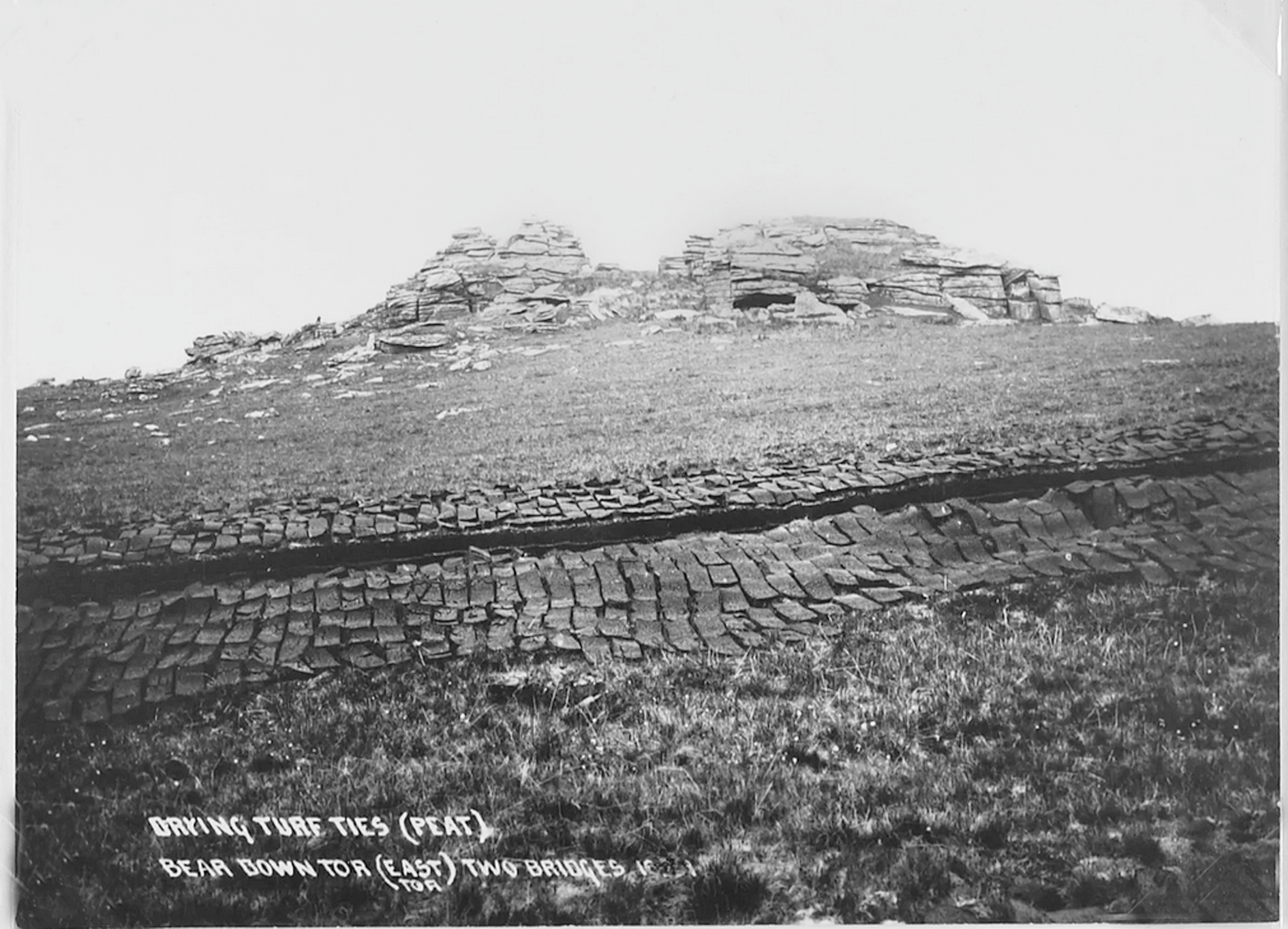
Drying turf tiles on the Moor © The Dartmoor Trust
Peat extracted from the moor was transported along horse-drawn tramlines before being taken back to the prison.
Dartmoor Prison itself has a long and unusual history. It first opened in 1809 as a war prison during the Napoleonic Wars and later held prisoners captured during the War of 1812. Thousands of captives were confined within its granite walls, which stretch nearly a mile in circumference.
When the wars ended, the prison closed in 1816 and remained largely unused for decades. During that period, entrepreneurs attempted to exploit the area’s peat deposits by converting them into naphtha - a flammable liquid fuel. The experiment ultimately failed because the resulting fuel proved poor in quality and commercially unviable.
The prison reopened in 1850 as a convict jail, and it was during this era that peat cutting became a routine part of prison labour. Convicts were marched onto the moor in supervised work parties, where they drained marshy land and extracted peat from the bogs.
The Report of the Directors of Convict Prisons (1865) describes the regime:
“The parties proceed to the moor under escort, and the labour, though severe, is considered suitable employment.”
Today, the same land has a very different role. Rain falling across Dartmoor’s uplands feeds rivers and reservoirs, including Burrator Reservoir, which supplies drinking water to thousands of customers of South West Water.
Healthy peatlands act like natural sponges. When waterlogged, they store carbon, slow rainfall run-off and gradually release water into streams and reservoirs. This helps protect water quality and reduces the impact of both drought and intense rainfall.
Morag Angus, Manager of the South West Peatland Partnership, says the transformation of the landscape is striking.
“It’s an amazing project and partnership to be part of, making our peatlands wetter and better for wildlife, water, people and the planet. Dartmoor’s peatlands are rich in archaeology and contain so much history. We’re working together to stop the peat from degrading further, carrying out surveys with our in-house archaeologists and commissioning research to learn more about these natural archives of human industrial activity.”
Conservationists are now working to repair centuries of environmental damage caused by drainage, peat extraction and erosion. Projects across Dartmoor focus on blocking artificial drainage channels, reshaping exposed peat and encouraging the return of sphagnum moss, a key plant that helps peatlands retain water.
Across the South West, more than 5,000 hectares of peatland have already undergone restoration work designed to slow the flow of water, reduce erosion and improve habitats for wildlife.
Morag says the process takes time.
“There’s still so much more to be done, and there’s no time to lose. It takes time to tackle hundreds of years of degradation. Some benefits from restoration are immediate for wildlife and water like dragonflies breeding in new areas. But carbon-rich peat will take much longer to begin to form again in some places.”
For historians, Dartmoor’s peatlands tell a powerful story about how attitudes to the natural world have changed.
Graham Edmondson believes the contrast between past and present is remarkable.
“The prisoners weren’t thinking about climate or hydrology. They were cutting fuel under orders and the moor was seen as a resource to be used. The idea that those blanket bogs would today be recognised as a vital, living system that stores water and supports resilience wasn’t part of their conversation as they marched onto the moor. That contrast is what makes the history so striking.”
What was once an industrial landscape worked by convict labour has become something very different - a fragile ecosystem, slowly being restored, that protects water, wildlife and climate across the South West.

Subscribe or register today to discover more from DonegalLive.ie
Buy the e-paper of the Donegal Democrat, Donegal People's Press, Donegal Post and Inish Times here for instant access to Donegal's premier news titles.
Keep up with the latest news from Donegal with our daily newsletter featuring the most important stories of the day delivered to your inbox every evening at 5pm.