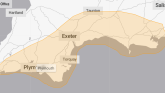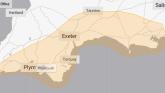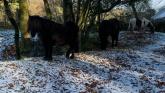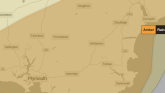
The Met Office says Storm Chandra will deliver heavy rain across south Devon, particularly over Dartmoor’s higher ground (Image- The Met Office)
Search


26 Jan 2026

Please allow ads as they help fund our trusted local news content.
Kindly add us to your ad blocker whitelist.
If you want further access to Ireland's best local journalism, consider contributing and/or subscribing to our free daily Newsletter .
Support our mission and join our community now.
To continue reading this article, you can subscribe for as little as €0.50 per week which will also give you access to all of our premium content and archived articles!
Alternatively, you can pay €0.50 per article, capped at €1 per day.
Thank you for supporting Ireland's best local journalism!

TB testing
Bovine TB is a disease that affects many species: humans, cattle, birds and many other mammals. England is working to eradicate Bovine TB as part of a 25-year strategy. At a practical level, most cattle on Dartmoor are tested every six months with a skin test to see if they may have this dreadful disease.
Testing every six months can be difficult with cattle grazing well away from the home farm out on the open moor and bringing cattle home for a TB test during the summer months disrupts their usual grazing pattern. The cattle will be brought to the home farm and retained on there for the week. The cattle are injected with two different types of dead TB bacteria, one from cattle and one from birds. It is the reaction to the cattle TB compared to the bird TB that provides a positive or negative result.
A positive result will mean that the animal will have to be slaughtered and the herd is put on restrictions preventing movements of cattle for a period. The whole herd will need to test clear of TB at two whole-herd TB tests that will be 60 days apart, so it takes a minimum of four months to check if a herd is clear of TB and enable the movement and sale of cattle.
If there is no clear test, then the herd remains on restriction. That means sales of cattle can only be to special TB market sales, or under licence to slaughter. Cattle can still graze the common as the herds are widely dispersed across the expanse of Dartmoor. No TB reactors are ever turned out on the common as TB reactors are slaughtered.
The Dartmoor Commons are unique in that they have developed a Dartmoor TB Control Plan, working with the Animal Plant Health Agency vets to create a plan that lists the cattle grazing on each common. This allows the vets to make informed decisions regarding TB control.
Fencing against common land
There are often issues with livestock that graze on the Dartmoor commons accessing the neighbouring ‘in by’ land. Owners of such land; farms, gardens, woodland or any land, even non-agricultural premises, must make sure the fence adjoining the common is fully stock proof. Part III, Section 9 of the Dartmoor Commons Act 1985, states that the custom on the commons is for the owner of any land not being part of the commons, to fence the land against any animals lawfully depastured on the common.
Traditional swaling
Swaling is a tradition carried out on many areas of scrub to enhance the biodiversity and condition of the commons for everyone to enjoy; the commons of Dartmoor are no exception. The vegetation is burnt in patches and this ensures there are different stages of the same habitat type; some old, some young and some ready to start growing again. During the 2020 and 2021, swaling was curtailed due to the COVID-19 pandemic. However, during 2022, and with some good weather windows, a normal seasonal amount of successful swaling was undertaken. So, subject to the appropriate weather and risk assessments it is hoped in 2023, that the commons who are in agreements with Natural England, and those that are not, can work closely with the Fire Service and the National Park to undertake safe practical swales up until the end of March, on common land. In upland areas that are non-common land then swaling can extend to 15th April. However, it is recommended that protecting bird-nesting season is considered as priority.
Further information about the work of the Dartmoor Commoners Council Dartmoor Commoners Council.
Under the Dartmoor Commons Act (1985), the Dartmoor Commoners' Council;was established;to represent the commoners, make regulations about most matters, which concern the;management of the commons and the welfare of the stock de-pastured on the commons, and to enforce the Dartmoor Commoners' Council Regulations.
The traditional role of managing the common land continues through the mixed animal grazing that has made Dartmoor the jewel that it is and hopefully it will continue with the commoners applying their knowledge and skills.

Subscribe or register today to discover more from DonegalLive.ie
Buy the e-paper of the Donegal Democrat, Donegal People's Press, Donegal Post and Inish Times here for instant access to Donegal's premier news titles.
Keep up with the latest news from Donegal with our daily newsletter featuring the most important stories of the day delivered to your inbox every evening at 5pm.