

Dartmoor reservoirs reveal hidden secrets

From hidden histories beneath Dartmoor’s reservoirs to mysterious moorland discoveries, David Phillips explores the curious, unexpected and sometimes downright peculiar sights he has encountered on his travels across the moor. From forgotten bridges and submerged settlements to pixies, gnomes and intriguing witchcraft connections, his quest to uncover Dartmoor’s secrets reveals a landscape full of surprises.
Ever since I started exploring the wilds of Dartmoor, I’ve often stumbled across unusual things, hidden in the landscape. Sometimes I’ve gone in search of them, sometimes I come across them by accident. Some are man-made, others are forces of nature, but, regardless, I like to record them, to share with others. So that is the purpose of this article, to share with you some of those findings, with relevant photos where possible. In those instances where I can’t give you photographic evidence, I will do my best to describe what I saw.
Let’s kick off with the inspiration behind this particular piece, and tell you all about my quest to find out what lies beneath the waters of some of Dartmoor’s reservoirs...
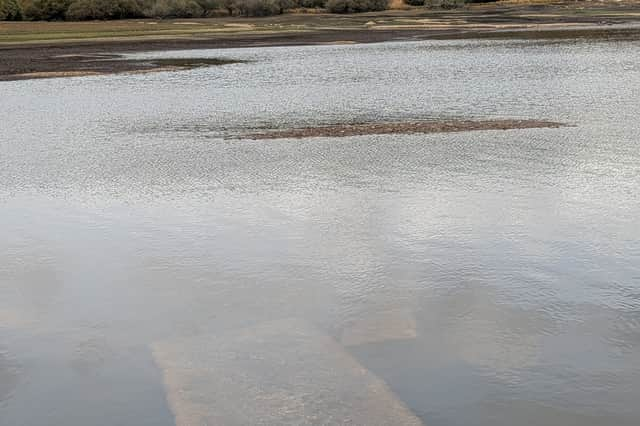
All through this past Summer of heatwaves and drought, Facebook has been awash with pictures of what the lack of water has revealed in the landscape below them. Structures that were purposely “drowned”, to make way for a permanent repository for our drinking water.
Some pictures date back to previous shortages, when our Summers were also equally hot (isn’t that what Summers are supposed to be...hot?), such as the infamous one of 1976 (I remember it well), when some jovial journalist was allowed to pose a skeleton in a deckchair, complete with fishing rod, at Fernworthy Reservoir, and make a topical statement, about the lack of water, and, consequently, lack of fish. Nowadays, you have to be careful that you aren’t making a statement about climate change!
Other pictures showed bridges and ancient artefacts that have been uncovered, and I became so intrigued, that I had to take a look for myself...
After leaving the Letterbox Meet, on clock change day, at Lee Moor, I headed towards Burrator Reservoir to see what the water levels were like there now, after the bit of rainfall we’d recently had. Parking up by the dam, I went for a little stroll, and took some pictures. Yes, you could see the banks around the edges, but it was hardly nearly empty, and there were certainly no structures poking out above the waterline. When it was constructed, back in 1898, old farmsteads, such as Essworthy Farm, and parts of Longstone Manor, along with ancient Bronze Age hut circles, were lost beneath the waters, and can appear at times of serious drought, but not on this occasion. Local myths suggest there is a whole village down there, complete with a church spire, but that certainly isn’t the case...that accolade belongs to Ladybower Reservoir up in Derbyshire.
Several local farms, not just the ones submerged, were forced to be abandoned, and left to fall into ruin, as they couldn’t be allowed to continue cultivating the land and using pesticides and other chemicals, for fear of contaminating the water table and thus poisoning the drinking water. It is said that the farmers and their families, often return to the area, to reminisce about what life was like before the reservoir, and view their old homes. I visited some of those ruins, earlier in the year, and it’s interesting to imagine what that area might look like now, if the reservoir hadn’t been built.
The main ruin, on the edge of Burrator, that is also worth a visit, is Longstone Manor. Again, is was the attached farm and outbuildings that were lost, the rest sits safely on the bank above. This place is of particular interest to me, as, during The English Civil War, one of its owners found himself on the losing side, and he was forced into hiding, when Oliver Cromwell’s men came looking for any stray Royalists, to round them up, and execute them.
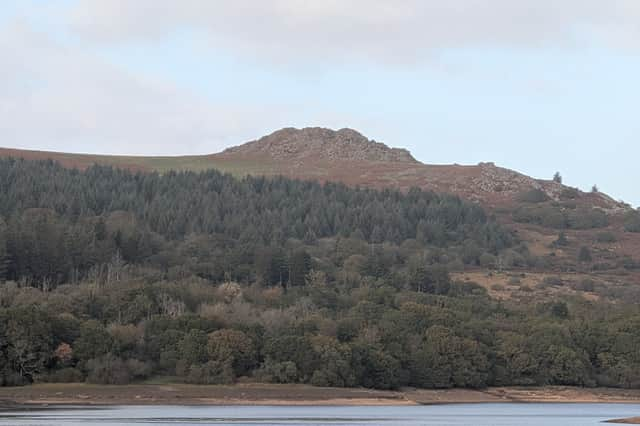
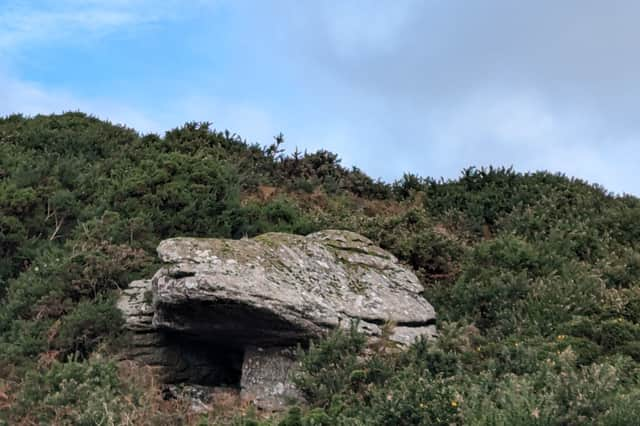
John Elford was his name, and when he got word that his life was in danger, he took refuge in the Pixie Cave, on Sheepstor. Whilst he was in hiding, his family and sympathetic locals, kept him fed and watered, until they were sure that the troops had left the area, and it was safe for him to return home.
It’s the Pixie Cave, that gave me one of my unexpected Dartmoor finds. When I first went in search of it, I failed to find it, as, even though it’s marked on the Ordinance Survey map as being on Sheepstor, once you start looking amongst the rocks, it’s not obvious. Fortunately, the next time I was in the area, I was in the company of someone who knew exactly how to find it, and I’ve been climbing inside ever since, to leave the all important offerings for the pixies. It was during one of these subsequent visits, that, after sliding inside on my back, I found myself face to face with one of them! No, not a real pixie, sadly, but a ceramic figurine of one. He was in a crevice in the rock face, at the back of the cave, obviously put there to keep an eye on the place, and to accept people’s gifts. Unfortunately, the next time I visited, he was gone...hopefully not stolen, but retrieved by his owner, to imbue their own home with some of that pixie magic.
It was another type of mythical creature, that features in another of my unusual moorland finds, this time it was a concrete garden gnome, and, just like the skeleton in his deckchair, he was complete with a fishing rod! My walking buddy, Dave, and I, stumbled across him as we were making the arduous, but oh so rewarding, trek to the Queen of the North Moor...Fur Tor. On the approach, you come to Flat Tor (lives up to its name), which has a sizable pool just below it, and someone had gone to the trouble of lugging the gnome all the way there, along with an amount of cement, to secure him to a rock, leaving him to fish in his pond, and raise a smile, with all those that followed in our footsteps, on this mammoth trek. I even took a picture of Dave, alongside our little friend, and after I posted it on Facebook, a magazine got in touch, asking if they could feature it in an article about unusual finds on the moor...it was the gnome they wanted...not Dave! We passed him on several occasions, until one time he was no longer there. I can’t imagine anyone would have gone to the trouble of carrying him all the way back to civilisation...instead, I’ve got a horrible feeling that he might now reside at the bottom of his pond, taking a closer look at his fish!
More oddly placed figurines, feature in my next unusual discovery, this time on Jay’s Grave, of all places. When I first started checking out the various displays of flowers, that allegedly mysteriously appear there, amongst some of the offerings, alongside a mountain of loose change, on top of the headstone, was Winnie the Pooh, Paddington, and Yogi Bear...once even Pluto (the Disney character, not the planet) showed up. These representations of bears and dogs weren’t really suitable offerings for a young girl, or her unborn child, so they got me wondering. Doing some research online, and in my extensive personal library, I came across the Greek goddess Hecate, who is said to rule over magic and witchcraft; the night; the moon; the dead and their ghosts...whose domain is the crossroads, and the boundaries of the known and the unknown worlds. So Kitty Jay’s Grave falls under her sway. This would explain why I was also finding handwritten messages from young girls (teenage witches, let’s say) asking for guidance and support in their endeavours. These weren’t meant for Jay, but for Hecate. The most intriguing part is that her familiars are dogs and bears, so these offerings were also for her. Interestingly, since I’ve been writing about my discoveries at the grave, no more have appeared. This is why I’ve incorporated Jay’s Grave into my Witches Triangle walk, as there is clearly a connection to the craft. The other point of the base of my triangle, is the granite pillar known as Bowerman’s Nose...a lesson in why you should be respectful to the Sisterhood! The tip of my triangle is Easdon Hill, where I made another discovery...the altar of Granny Mann. She was a white witch, who lived nearby, in North Bovey, and who would come to a particular outcrop on the hillside, known as Boodown Rocks, to perform her rituals and spellcastings in secret, by the light of the rising moon, accompanied by her “friend”, a human skull, which now resides in Boscastle Witchcraft Museum, and is one of my favourite exhibits there.
Meanwhile, back at the dam, I took my pictures of the low waters, and posted them on Facebook, where, in one comment, I was accused of being a “paid activist”! I can only presume they thought I was doing my bit to highlight climate change, when in fact I was only documenting the scenery for posterity, and to share it with those who can’t visit for themselves. Undeterred, I went on to visit the other Dartmoor reservoir, that has been revealing its secrets this Summer, at Fernworthy.
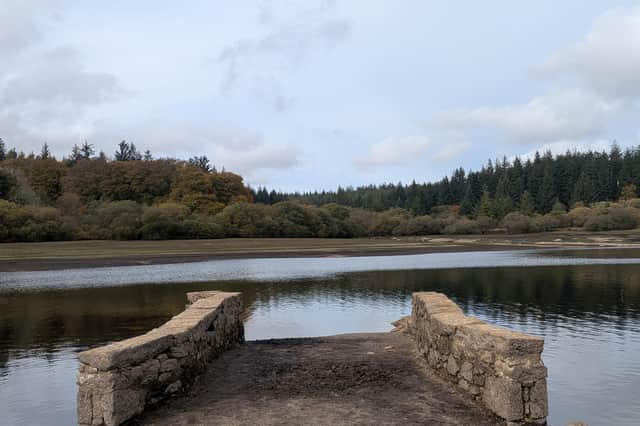
It would appear I got there just in time, for pictures posted a few days previously, show a clapper bridge, a granite slab over the South Teign River, to allow dry passage for pack animals, and a humped backed bridge for a similar purpose, completely above water. Now, the clapper was already starting to be submerged beneath the surface, and only the walls of the arched bridge remained above. One approach to it was still accessible, the other side was already lost to the waters, showing that, after the recent storms, nature is already fighting back.
Other antiquities, revealed by the low levels, include more Bronze Age settlements, with hut circles and stone rows; tree stumps; evidence of Tudor tin mining; and the remains of Fernworthy Farm itself.
Legend has it that building work carried out on the dam, back in 1938, was hampered by heavy storms, and a massive flood, that washed a crane into the river. This disruption was attributed to a tribe of local gnomes, showing their displeasure at their land being desecrated in this way...
I was glad I took the opportunity to go and see for myself, what lies beneath the waters at Fernworthy Reservoir, and stand on land that might not be accessible for a while yet...or will it become an annual event? Controversial!
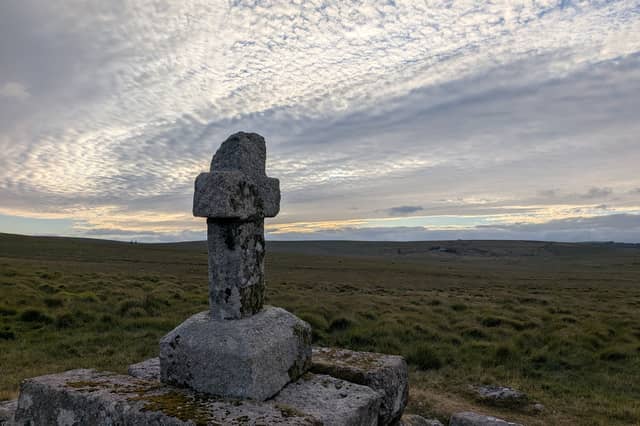
Finally, I want to share with you something that left me a little bit disturbed, when I stumbled upon it. It was a few years ago now, and I was just returning from an expedition to the Fox Tor area. I was starting to lose the light, when I decided to go and pay my respects to Childe the Hunter, at his tomb, which marks the spot where he sadly lost his life whilst out hunting, during a particularly harsh Winter, many years ago. Whilst there, I proceeded to take photos of the cross, on the raised plinth, from all sides. As I reached the part where some of the granite slabs are missing, leaving the interior exposed, my heart nearly stopped, for there was a face looking back at me! It took me a few seconds to realise this wasn’t a human face, it was on the head of a mannequin, that someone had gone to the trouble of transporting all the way to this remote spot, and leaving it in the tomb, looking out. Not surprisingly, I was a little bit distracted, on my walk home in the dark that night!
Sadly, when I next visited the tomb, the head was gone. Like so many of the oddities I’ve come across on my travels, they don’t stay very long. I feel honoured that I was able to witness them when I did. Who knows what other unusual sights I will come across, in the future, during my adventures in the wilds of Dartmoor...