

This is Hallowe'en

From the Celtic festival of Samhain to modern Wiccan rituals, Halloween has a much deeper story than pumpkins and spooky costumes. With its ancient stone circles, mist-shrouded tors and centuries of tales about witches and pixies, Dartmoor is the perfect place to explore the magic of the season.
As October draws to a close and darkness settles over the moor, Dartmoor seems to take on a different character. Granite outcrops emerge from swirling mist, the wind whips through the gorse, and familiar tracks disappear into the gloom. It is easy to see why generations past have filled this landscape with stories of witches, wandering spirits and mischievous pixies.
For many people, Halloween is now an evening of carved pumpkins, fancy dress and children knocking on doors for sweets. But beneath the modern celebrations lies a wonderful mixture of seasonal and Christian traditions, folk beliefs and contemporary pagan spirituality.
This time of year can also be an opportunity to honour ancestors, reflect on the cycle of life and death, and acknowledge the turning of the seasons. While Dartmoor's legends cannot all be traced to ancient pagan beliefs, its particular landscape provides a fitting backdrop for exploring the enduring relationship between people, nature and the supernatural.
The origins of Halloween
The name Halloween comes from All Hallows' Eve, meaning the evening before All Saints' Day on November 1. Together with All Souls' Day on November 2, the Christian calendar established a period for remembering its saints and departed loved ones.
However, Halloween is also commonly associated with Samhain (pronounced sow-in), a festival originally observed in parts of Ireland and Scotland, associated with the end of summer and the beginning of winter. Historically, this was a significant turning point in the agricultural year. Harvesting was drawing to a close, livestock might be brought in or slaughtered for the winter, and communities prepared for the colder, darker months ahead.
The festival's ancient customs are not fully documented, and historians caution against assuming that every modern Halloween tradition has survived unchanged from pre-Christian times. Nevertheless, Samhain became closely associated with the supernatural in later folklore, including beliefs about encounters with otherworldly beings during the transition between seasons.
The idea that the boundary between the living and the dead becomes thinner at this time of year has proved particularly enduring. It is a theme that runs through ghost stories, traditional Halloween customs and many contemporary pagan celebrations. Fire also features prominently in accounts of seasonal festivities. Bonfires could mark an important moment in the agricultural calendar, while later folklore associated them with protection and purification.
Over centuries, Christian traditions and local folk customs influenced one another, creating the rich mixture of traditions we recognise today.
Many of Halloween's familiar customs have their own fascinating histories. In parts of Britain and Ireland, people once carved faces into turnips and other root vegetables to make lanterns. These could be placed in windows or carried outdoors, in an attempt to frighten away any unwanted spirits that may have made it through the veil on this night.
When Irish and Scottish emigrants took their Halloween traditions to North America, pumpkins offered a larger and easier vegetable to carve. The pumpkin lantern subsequently became one of Halloween's most recognisable symbols.
Another precursor to modern trick-or-treating was 'souling', when people went from house to house around All Souls' Day asking for food or small cakes in return for prayers for the dead. Householders would make 'soul cakes' specifically to give out for this purpose. I'll include a recipe at the end of the article if you would like to make your own. Other regional customs involved dressing up, playing tricks and visiting neighbours. Yet for those who observe Halloween as a spiritual occasion, the meaning can be much more personal than a night of harmless frights.
For many modern Wiccans and other contemporary pagans, Samhain is one of the most important dates in the spiritual calendar. Wicca is a modern pagan religion that emerged in the mid-20th century. Many Wiccans follow a seasonal cycle known as the Wheel of the Year, which includes eight festivals marking seasonal changes and points in the agricultural year. Samhain sits opposite Beltane, the springtime celebration associated with fertility and the beginning of summer in the Wheel of the Year. Interestingly, Beltane is also a time when the veil between the worlds thins, but the Spring festival is more likely to draw the faeries to our world than the spirits of the dead. Where Beltane celebrates growth, vitality and new beginnings, Samhain invites reflection on endings, rest and the inevitability of change.
For many practitioners, it is a time to remember deceased relatives, honour ancestors and reflect on the lives that came before their own. Some believe that communication with the dead or the spirit world is more accessible at this time; others approach the festival symbolically, using it as an opportunity to remember loved ones and consider their own mortality.
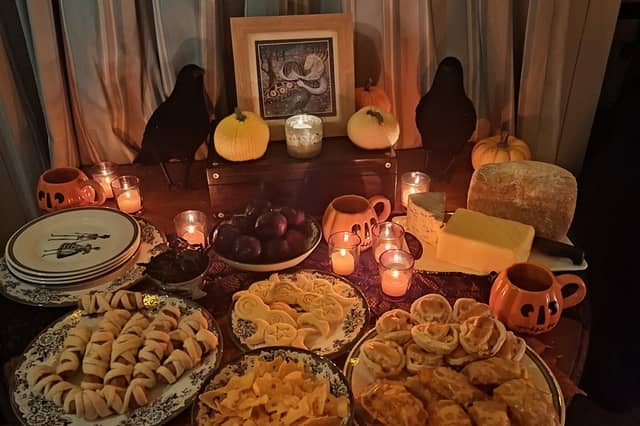
Altars might be decorated with autumn leaves, apples, nuts, seasonal flowers, photographs of departed relatives and candles. A meal may be prepared in memory of loved ones, with a place left empty as a symbolic gesture of remembrance. Divination, meditation, journalling and quiet reflection may also form part of the evening. For many, the emphasis is not on frightening spirits but on acknowledging the full cycle of life: birth, growth, decline, death and renewal.
We are lucky to have such an evocative setting for Halloween in our beloved Dartmoor. Its dramatic granite tors, ancient stone rows, prehistoric burial sites and isolated stretches of moorland have inspired stories for generations. The weather can transform the landscape in minutes, turning an open hillside into a world of mist and shadow. Dartmoor's collection of local legends includes tales of witches, giants, pixies, ghosts and the Devil himself. These stories offer a glimpse into the hopes and fears of earlier communities, when strange events and unfamiliar landscapes were often explained through supernatural beliefs.
One of the best-known local stories is the legend of Bowerman's Nose, the striking granite tor near Manaton. According to the tale, Bowerman was a hunter who pursued a hare across the moor, unaware that it was a witch in disguise. The chase led him into a trap, where the witches turned him and his hounds to stone. The rock formation is said to be Bowerman himself, with the surrounding stones representing his dogs. On misty or moonless nights, some versions of the legend claim that the sound of the hunt can still be heard.
Perhaps one of Dartmoor's most poignant legends is that of Kitty Jay, whose grave lies on the eastern side of the moor. Kitty was a young farmworker who died by suicide in the 18th or 19th century after becoming pregnant and being abandoned by her lover. The precise historical details are uncertain, and the story has been retold in different forms.
In the time when the legend is set, people who died by suicide were denied burial in consecrated ground. According to local tradition, Kitty was buried at a crossroads – this was a traditional way of ensuring the wandering spirit could not find its way back home. Perhaps this gives some clue as to the guilt felt by the one who had spurned her; he knew what he had done and maybe feared that Kitty's spirit would haunt him for his bad behaviour.
Her grave became the focus of an enduring mystery because fresh flowers have repeatedly been found there, despite the identity of those leaving them remaining unknown. Some local stories attribute the flowers to pixies, while others have imagined a human visitor quietly maintaining the grave. The continuing offerings have helped keep Kitty's story alive, a story which is not simply one of haunting, but also a reminder of the social judgements faced by vulnerable women in the past, and of the compassion that can survive long after the circumstances of a person's life have been forgotten.
Dartmoor's supernatural inhabitants are not limited to witches and ghosts. Pixies, often known locally as piskies, have long occupied a special place in Devon folklore. Unlike the tiny, delicate fairies of modern illustrations, Dartmoor's pixies could be mischievous, unpredictable and occasionally dangerous. Stories tell of travellers being led astray into bogs and unfamiliar valleys by mysterious lights or music. Someone who lost their way in the mist would be described as having been 'pixie-led'. One remedy was to turn your coat inside out, supposedly breaking the pixies' spell and allowing you to find the right path again.
There is something especially appropriate about remembering such stories at Halloween, when the ordinary world seems to make room for the extraordinary. For those who feel a spiritual connection with the natural world, Dartmoor's folklore may also provide inspiration for reflecting on the relationship between people and the landscapes they inhabit, inviting a sense of wonder about the world beyond everyday routines.
The arrival of winter once meant a profound change in daily life. Days grew shorter, temperatures fell and communities faced months when food and fuel needed to be carefully managed. Today, modern heating, electric lights and supermarkets have removed many of those seasonal challenges. Yet autumn still encourages us to slow down, take stock and prepare for a different rhythm of life. That seasonal transition lies at the heart of Samhain for many.
Rather than viewing darkness as something inherently evil, the festival can be an opportunity to recognise that rest and endings are necessary parts of life. Trees shed their leaves, plants retreat underground and the land enters a quieter phase before spring's renewal. This natural cycle can provide a framework for personal reflection. What needs to be left behind? Which memories deserve to be carried forward? What lessons can be drawn from the past, and what might be allowed to rest until a new beginning becomes possible?
Such questions are not exclusive to pagan spirituality. People of many faiths and none find meaning in remembering loved ones, spending time outdoors and acknowledging the changing seasons. Dartmoor, with its ancient monuments and enduring folklore, provides a powerful setting in which to consider those themes. Its legends remind us that people have long looked at the landscape and seen more than stone, water and vegetation. They have found stories, warnings, wonder and explanations for the things they could not understand. Whether we approach those stories as folklore, history, spiritual inspiration or simply good tales to share beside a fire, they remain part of our cultural heritage.
Marking Halloween the Dartmoor way
You do not need to practise Wicca or believe in the supernatural to enjoy a more thoughtful Halloween. A walk through the autumn landscape, a visit to a local museum to explore Dartmoor's legends, or an evening spent sharing traditional stories can offer a welcome alternative to the commercial side of the season. At home, you might light a candle in memory of someone you miss, cook with seasonal apples and pumpkins, or take a little time to reflect on the year that has passed.
Those who follow a pagan path may choose to mark Samhain with a more formal ritual, perhaps decorating an altar with natural objects or gathering with others to honour the season. And if you venture onto Dartmoor after dark, remember that the landscape is both beautiful and potentially hazardous. Weather changes quickly, visibility can deteriorate and familiar paths may be difficult to follow. Check conditions, carry appropriate equipment and avoid wandering onto unfamiliar ground in darkness or fog.
Perhaps the most fitting way to celebrate Halloween here is to remember that the moor's greatest magic does not depend on whether we believe in witches, ghosts or pixies. It lies in the way the landscape captures our imagination, connects us with generations past and reminds us that the natural world follows rhythms much older than our own.
As the last light fades behind the tors and the first stars appear above the moor, it is easy to understand why this has always been a place for stories, and on Halloween night, with the wind rising and the mist gathering in the valleys, Dartmoor's ancient tales seem closer than ever.
Soul Cakes
Ingredients -
300g plain flour
2tsp ground mixed spice (I'm a lover of cinnamon so always add a little extra cinnamon here)
150g butter, cubed
150g caster sugar
75g currants/raisins
2 egg yolks
2tbsp milk
1tbsp oats
½ tbsp cider vinegar
Method -
Heat the oven to 180 degrees.
Sift the flours, spices and a pinch of salt into a bowl. Add the butter and rub in to the flour mix until it resembles breadcrumbs. Add the sugar, oats and currants and mix together.
Make a well in the centre of the mix and add in the whisked egg yolks, milk and cider vinegar. Mix until combined.
Flour your work surface and roll out the dough until it's about 5mm thick. Cut into rounds using a cookie cutter and score the top of each cake with a cross using a sharp knife. Make sure you don't cut all the way through the dough.
Bake for about 20 minutes, depending on your oven, until they look slightly golden. Cool on a wire rack.